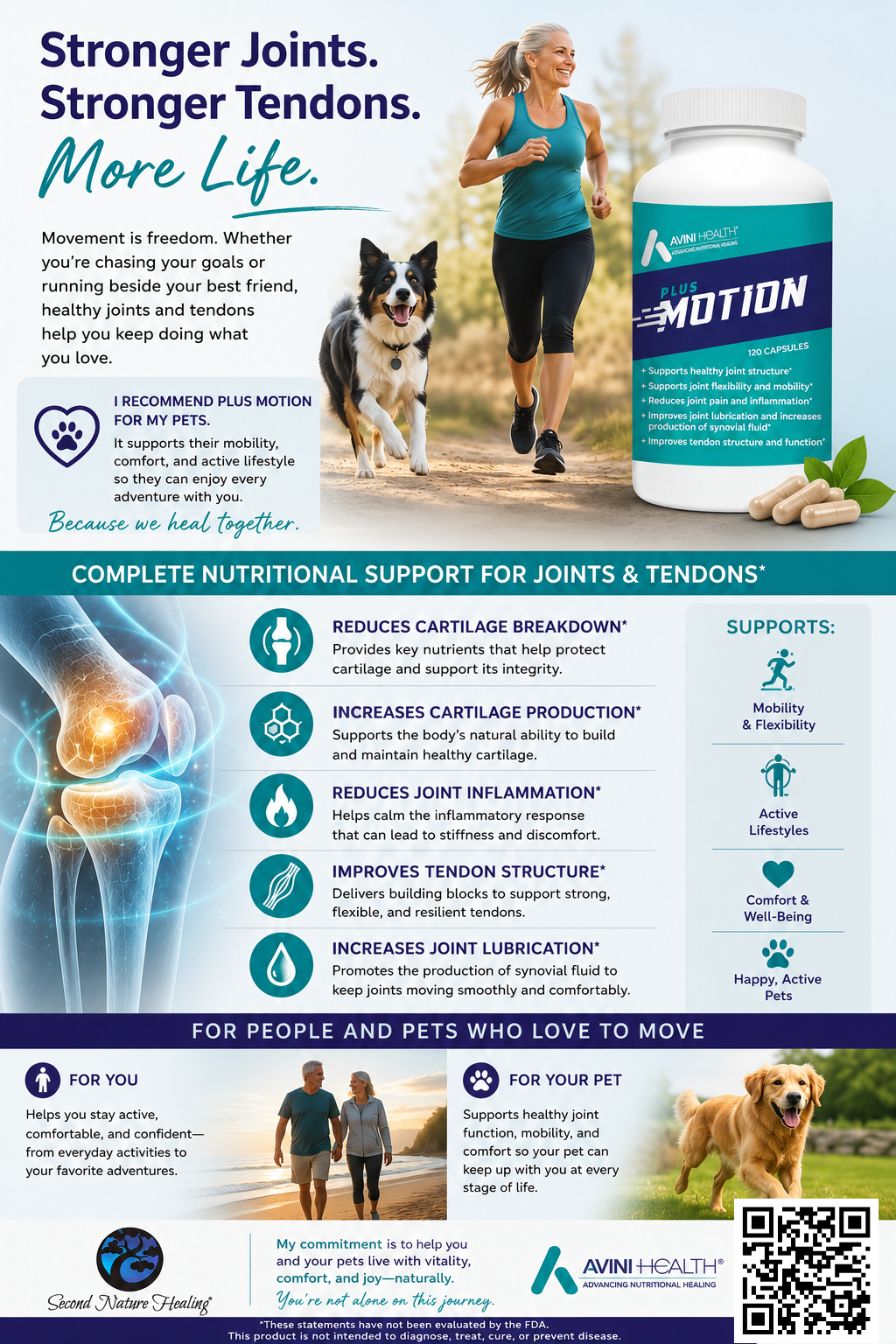
The Story of Cartilage, Synovial Fluid, Circulation, and Possibilities
For decades, we've heard the same message from both human and veterinary medicine: once cartilage is gone, it's gone. In fact, I hear it often from people I know. "My doctor told me . . . ". and "It's impossible to heal knees when you're bone-on-bone." Maybe you've also accepted that as an unchangeable fact. When knees begin to ache, hips become stiff, or your beloved dog starts hesitating before jumping into the car, the expectation is often that deterioration will simply continue. The conversation quickly turns toward pain management, anti-inflammatory medications, or eventually surgery. Those might be temporary "fixes", but I'm wondering if you'd like to explore a long-term idea for ways the body can heal.
Science has a way of changing what we believe. I've put a lot of trust into science, having a biology degree in education. But what I learned years ago was never taught in any curriculum. I studied anatomy and physiology. I knew the workings of body tissues and organs but not the capabilities of healing. The possibilities for healing were never mentioned - a huge miss when it came to my own experiences with my mom.
Today, researchers recognize that cartilage is not simply an inert material that slowly wears away over time. It is living tissue maintained by specialized cells called chondrocytes. Although cartilage has a limited blood supply and repairs much more slowly than skin or muscle, researchers now understand that it continues to remodel throughout life. In fact, regenerative medicine has become one of the fastest-growing areas of orthopedic research, with scientists exploring ways to stimulate and support the body's natural ability to maintain healthy cartilage.
That doesn't mean every damaged joint can be restored to perfect condition. It does mean we've moved beyond the outdated belief that nothing can be done.
I find that encouraging, not only for people but for the animals we love.
Whether I'm working with an older Labrador, an agility Border Collie, or someone whose knees no longer allow them to enjoy hiking, I don't begin by asking, "How do we stop the pain?" I begin with a different question.
What does healthy joint tissue need in order to thrive?
The answer is rarely just one thing.
Healthy cartilage depends on an environment that supports it. It needs appropriate movement to nourish the joint, balanced inflammation, good hydration, quality nutrition, and the raw materials required to continually maintain connective tissue. When one of those pieces is missing, the entire joint begins to struggle. When several of them improve together, the body often responds in remarkable ways.
One concept I return to again and again is circulation.
Cartilage has very little direct blood supply, which is one reason it heals so slowly. Instead, it relies on nutrients moving through the surrounding joint fluid. Every comfortable step, every gentle walk, and every range-of-motion exercise helps circulate synovial fluid through the joint, delivering nutrients while carrying away metabolic waste. I often tell my clients that nutrition supplies the building blocks, but circulation delivers them. Without delivery, even the best nutrients can't reach the tissues that need them most.
This is one reason I rarely look at supplements in isolation.
When I recommend Avini products like Avini Plus Motion, Avini Plus Hydration, and Avini Plus Cardio Care, it's because I believe they provide not only nutritional building blocks that support healthy joint structure, tendon integrity, cartilage maintenance, but also normal joint lubrication. When those nutrients are combined with movement, healthy circulation, hydration, and thoughtful daily care, I've seen dogs and people maintain active lifestyles far longer than many expected.
Although Avini Plus Motion and other Avini products were developed for people, I frequently recommend them for dogs as well. The biology of connective tissue doesn't suddenly change because our companions walk on four legs instead of two. Dogs experience many of the same challenges we do. They age, develop arthritis, and compensate after injuries. Athletic dogs place tremendous demands on their joints through agility, hunting, flyball, and everyday play. Supporting healthy connective tissue simply makes sense.
Perhaps the most exciting change isn't the science itself. It's the hope it offers.
Instead of believing that joint degeneration is simply a one-way journey, we're beginning to appreciate the incredible capacity of living tissues to respond when they're given the support they need. We may not be able to turn back the clock completely, but we can certainly influence how comfortably we move through the years ahead.
That's what What's Possible? is all about.
It's about replacing outdated beliefs with informed possibilities, asking better questions, and giving both ourselves and our animals every opportunity to live with vitality.
Living with Vitality
Join the conversation. We meet Saturdays on Zoom. You're invited to join live for free, and get all the resources, downloads, and recordings when you register.